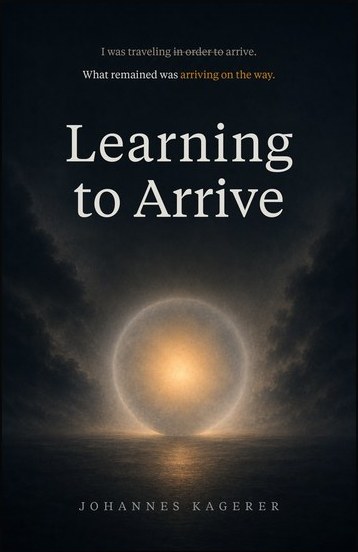
Literary Memoir

On the Way to Arrive

A journey toward gentleness and self-determination

The manuscript is in German. An English edition may follow at a later stage.
Publisher enquiries are welcome.

About the book

On the Way to Arrive (GER: Unterwegs um anzukommen) is a literary memoir about finding peace with past experiences — about relationship, responsibility, and the quiet work of arriving at oneself. The narrator grows up between closeness and violation, leaves his homeland, traverses countries, cultures, and relationships — and comes to understand that healing is not a destination, but a stance.

The book does not tell a story of transformation. It tells of the conscious decision to stop using one's own history as an excuse — and to face what was, without hardening or losing oneself. At the centre stands the question of how a person can remain present and open, even when the past has left its marks.

Travel and movement form the outer frame. The real confrontation happens within.

Arriving is not redemption — it is a moment of presence: sober, vulnerable, self-responsible.

From the manuscript

Tone & Style

The language is precise and reduced — clear observation without pathos. The text works through compression rather than explanation, avoids dramatising attributions, and remains consistent in both stance and rhythm. Stylistically, the book draws on the concentration and clarity of Ernest Hemingway and the intellectual openness and tolerance for ambivalence of Milan Kundera.

In a time when questions of meaning are often simplified or commodified, this book offers a quiet counterpoint. It deliberately forgoes narratives of redemption and transformation — instead opening a space for presence, precision, and self-responsibility.

Voice

A man writing openly about vulnerability and the search for inner peace — without accusation, without self-pity — remains rare in German-language literature. This manuscript does not describe a story of coping, but a stance that requires no staging and resists the familiar trauma-and-healing narratives. It offers a form of strength that is quieter, more precise, and more contemporary.

Request exposé or sample chapters →